

The day I saw my competitor's affiliate link show up inside a ChatGPT answer changed everything I thought I knew about traffic.
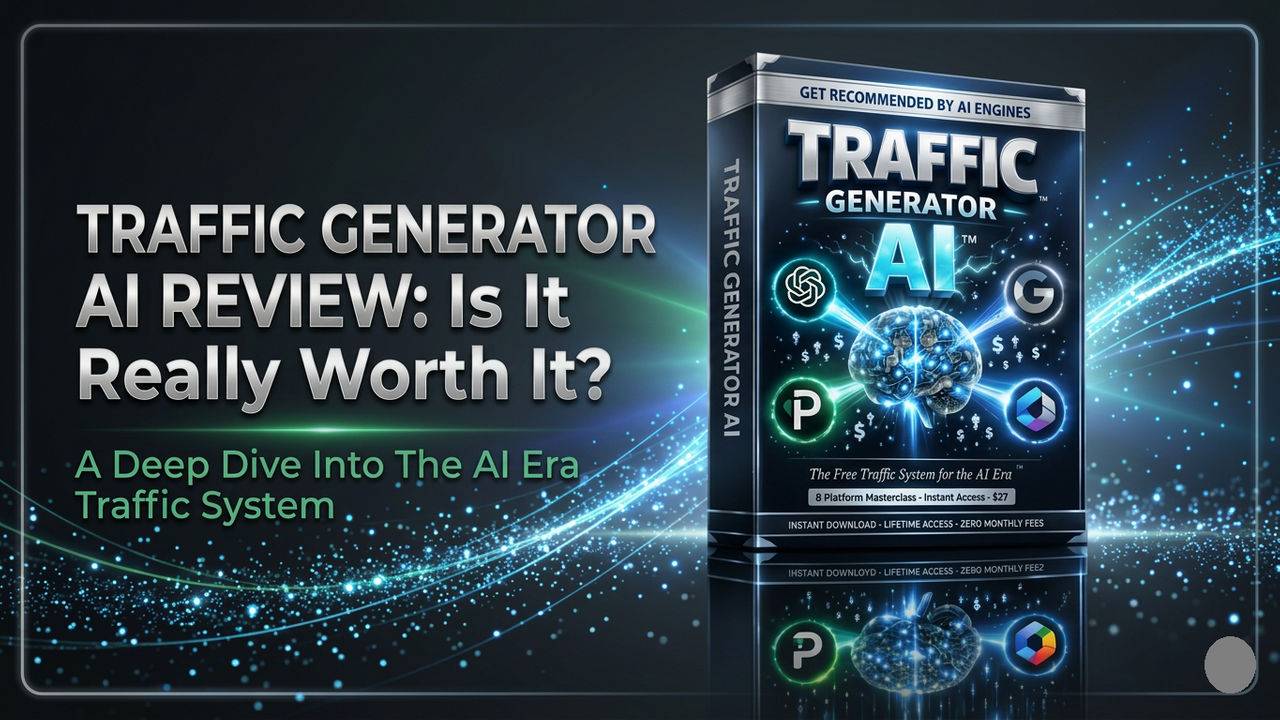
Traffic Generator AI Review 2026: I Tested This $17 GEO Course for 3 Weeks — Here's What ChatGPT Actually Recommended
Affiliate Disclosure: This review contains affiliate links. If you purchase Traffic Generator AI through my link, I may earn a commission at no extra cost to you. I only recommend products I've personally tested. All opinions here are my own based on real experience.
I'm going to be straight with you right from the start.
Google traffic isn't what it used to be.
I've been running affiliate sites since 2021. For the first couple years, things were good. My rankings climbed. Traffic grew. Commissions came in.
Then 2024 hit. And 2025 got worse.
My best-performing posts started slipping. Pages that brought in 300 visits a day dropped to 80. Then 40. Some disappeared entirely from the first page.
I tried everything. Rewrote content. Added more keywords. Built backlinks. Nothing stuck.
Then something weird happened in January 2026.
A friend sent me a screenshot. He'd asked ChatGPT for the best project management tools. ChatGPT gave him a list. And right there in the response was a competitor's affiliate link. Not mine. Not a big brand. A solo affiliate marketer just like us.
I didn't believe it at first.
So I opened ChatGPT myself. Asked it a few questions in my niche. And sure enough — it was citing specific blog posts, YouTube videos, even Reddit threads. With links.
That's when it hit me. People aren't just using Google anymore. They're asking AI tools for recommendations. And those tools are pulling from somewhere.
The question is: are they pulling from YOUR content? Or someone else's?
That's what led me to Traffic Generator AI.
I found it on a launch calendar. The sales page was a little hyped up. I'll admit I rolled my eyes at some of it. But the core idea made sense.
Get your content cited by ChatGPT, Perplexity, Gemini, and other AI engines. Without paid ads. Without a website if you don't have one. And without spending months waiting for Google to notice you.
At $17, I figured worst case I'd lose the price of two coffees.
Best case? I'd find a new traffic channel before everyone else figured it out.
So I bought it. Went through all eight modules. Posted content on five of the eight platforms they recommended. And tracked what happened for three weeks straight.
This review is what I found. The good parts. The frustrating parts. And whether this thing actually works or if it's just another overhyped course.
No fluff. Just what happened when I tested it myself.

What Exactly Is Traffic Generator AI? (And What It's Not)
Let me clear this up right away because the name is a little misleading.
Traffic Generator AI is NOT software. It's not an app. There's no dashboard. You're not automating anything.
It's a training course.
Specifically, it teaches you a strategy called Generative Engine Optimization — or GEO for short.
Here's the simplest way I can explain it.
You know how Google crawls websites and ranks them based on backlinks, keywords, and domain authority? That's SEO.
GEO is different. It's about getting AI engines like ChatGPT, Perplexity, Claude, and Google's AI Overviews to cite and recommend your content when people ask them questions.
And here's the kicker: these AI tools don't just pull from random websites. They pull from specific platforms that they already trust.
Traffic Generator AI shows you exactly which eight platforms those are. And it gives you step-by-step playbooks for how to post on each one so your content gets picked up.
The idea is simple. You create what they call "traffic assets" — basically content formatted in a way that AI engines can easily read and cite. You post those assets on the eight platforms. And over time, when someone asks ChatGPT or Perplexity a question in your niche, your link starts showing up in the answer.
No website required. No paid ads. No waiting six months for Google to index you.
You're essentially hijacking the platforms that AI already trusts and using them to drive traffic to your offers.
Now here's what it's NOT.
It's not a get-rich-quick scheme. Results take weeks, not days.
It's not a software tool. You're doing the work yourself using the templates and prompts they give you.
And it's not a magic button. You still need to create content. It's just that the content is designed specifically to get cited by AI instead of ranked by Google.
That distinction matters. Because a lot of people are going to buy this thinking it's some kind of automated traffic bot. It's not. It's a strategy course that teaches you where to post and how to format your content so AI tools recommend you.
If you're cool with that, keep reading. If you want push-button automation, this isn't it.


Why I Even Tried This in the First Place
I told you my Google traffic tanked. But let me give you the actual numbers because I think it'll help you see why I was desperate enough to try something new.
In December 2024, my main affiliate site was getting about 4,200 visitors a month. Not huge, but enough to make a decent side income.
By March 2025, that number dropped to 2,800.
By June 2025? 1,400.
I was losing more than half my traffic in six months. And I had no idea why.
I checked Google Search Console. Some pages just vanished. Others got pushed to page two or three. A few helpful content updates hit. An algorithm tweak here. A core update there.
Every time I thought I had it figured out, another update would come through and wipe out whatever progress I'd made.
Around that same time, I started noticing people in Facebook groups talking about "AI traffic." Most of it sounded like conspiracy theory stuff at first. People saying ChatGPT was going to replace Google. That Perplexity was the new search engine.
I didn't pay much attention until my friend sent me that screenshot I mentioned earlier.
He showed me a ChatGPT conversation where someone asked, "What's the best budgeting app for freelancers?"
ChatGPT responded with a paragraph. And at the end, it linked to a Medium article. My friend's Medium article. The one with his affiliate link in it.
He told me he'd been getting clicks from ChatGPT for two weeks. Not a ton — maybe 10 to 15 a day. But they were coming in consistently. And he wasn't paying for ads. He wasn't posting on social media. He just wrote one article, posted it on Medium, and ChatGPT started citing it.
That's when I started digging.
I found a few free guides on something called GEO — Generative Engine Optimization. The concept made sense. But everything I found was either super technical or just surface-level theory.
Then I came across Traffic Generator AI on a product launch site. The price was $17. The sales page was a little over the top. But the promise was exactly what I was looking for: a step-by-step system for getting your content cited by AI tools.
I bought it that same day.
I wasn't expecting miracles. I just wanted to see if this was a real strategy or if it was all hype.
Spoiler: it's real. But it's not instant. And it's definitely not passive.

First Impressions: What You Get When You Buy
When you buy Traffic Generator AI, you get instant access to a members' area. It's hosted on a simple course platform. Nothing fancy. No bells and whistles. Just a clean dashboard with all the modules laid out.
Here's what's inside:
Eight platform playbooks. Each one focuses on a specific platform that AI engines already trust. They don't reveal all eight on the sales page, but I'll tell you a few: Reddit, Medium, Quora, LinkedIn. Each playbook is a video walkthrough plus a written guide. Some are longer than others. More on that later.
The AI Visibility Blueprint. This is the foundational training. It explains why AI tools cite certain content and ignore others. It's basically the theory behind GEO. I watched this first and it made everything else click.
Ready-to-use AI prompts. A library of prompts you can drop into ChatGPT to generate your traffic assets. These save a ton of time. You paste the prompt, fill in your niche, and ChatGPT spits out a formatted post.
The "Are You Showing Up?" check. This was my favorite part. It shows you three ways to test whether your content is actually getting picked up by AI tools. Most people post content and never check. This teaches you how to verify.
Done-for-you templates. Pre-built content templates for all eight platforms. You just fill in the blanks with your niche and offer. These are formatted specifically for AI citation.
Lifetime access. One payment. No monthly fees. You own it.
Two bonuses. GEO content templates and a Facebook Group Poster Tracker spreadsheet. I'll get into those later.
The whole thing took me about three hours to go through the first time. I watched all the videos at 1.5x speed. Then I went back and rewatched the platform playbooks I planned to use.
The training itself is solid. Not overly polished. No fancy graphics or animations. Just screen recordings and straightforward explanations.
What I liked immediately: the templates. They're genuinely useful. I used them for my first few posts and they saved me from staring at a blank screen.
What annoyed me right away: some of the platform playbooks are short. One of them was literally a 10-minute video. I would've liked more depth on how to optimize each platform.
But overall, for $17, I wasn't mad about it.


The Core Idea: How AI Traffic Actually Works
Before I get into my test results, I need to explain how this whole thing works. Because if you don't understand the concept, the strategy won't make sense.
Here's the basic breakdown.
When someone asks ChatGPT or Perplexity a question, the AI doesn't make up an answer out of thin air. It pulls information from sources it trusts.
Those sources are usually:
- High-authority websites (think Medium, LinkedIn, Reddit)
- Q&A platforms (Quora, Stack Exchange)
- Video platforms (YouTube)
- Visual platforms (Pinterest, Instagram)
- Professional networks (LinkedIn again)
The AI reads the content on those platforms, synthesizes it, and presents it as an answer. Sometimes it cites the source directly. Sometimes it just pulls the info without a link.
The goal of GEO is to structure your content in a way that makes it easy for AI to read, understand, and cite.
That means:
- Clear, concise answers to specific questions
- Structured formatting (headings, bullet points, numbered lists)
- High-quality platforms that AI already trusts
- Content that's useful, not spammy
Traffic Generator AI teaches you how to do all of that across eight different platforms.
Here's the part most people miss. You're not trying to rank on Google. You're trying to get cited by AI. That's a completely different game.
With Google, you need backlinks, domain authority, and months of waiting.
With AI, you need clarity, usefulness, and the right platform. That's it.
The content can be posted today. If it's formatted correctly and posted on the right platform, AI can start citing it within days or weeks.
Not always. But it happens faster than Google ever did for me.
And here's the other thing. Once AI cites your content, it can keep citing it for months or even years. Because the AI isn't constantly changing like Google's algorithm. It just pulls from the same trusted platforms over and over.
So if you post something useful on Medium today, and ChatGPT starts recommending it, that recommendation can compound over time.
That's the power of this strategy. It's not about going viral. It's about getting consistent, predictable citations from AI engines that send traffic your way on autopilot.
At least that's the theory. Let me tell you what actually happened when I tested it.
My 21-Day Test: What I Actually Did (Week by Week)
I'm going to break this down week by week so you can see exactly what I did and what happened.
Week 1: Setup and Learning
Day 1-3: I went through all eight modules. Took notes. Watched the AI Visibility Blueprint twice because it's the foundation for everything else.
I chose five platforms out of the eight to focus on. I skipped two because they didn't fit my niche (finance). And I skipped one because I just didn't want to deal with it.
The five I chose were Reddit, Medium, Quora, LinkedIn, and YouTube. I already had accounts on most of them. For the ones I didn't, I created new ones.
Day 4-5: I used the AI prompts to create my first batch of content. I picked a topic in my niche — "best budgeting apps for freelancers" — and generated five different traffic assets.
One for each platform. Each asset was formatted slightly differently based on the platform playbook.
For Reddit, I wrote a detailed post in a relevant subreddit. For Medium, I wrote a long-form article. For Quora, I answered a popular question. For LinkedIn, I posted a quick tip. For YouTube, I created a simple screen recording with a voiceover.
I used the templates for most of these. Filled in the blanks. Made a few tweaks to sound more natural. And that was it.
Day 6-7: I posted everything. Reddit post went live first. Medium article took a few hours to get published. Quora answer was instant. LinkedIn post was instant. YouTube video took a day to process.
By the end of week one, I had five pieces of content live on five different platforms. All of them linked back to the same affiliate offer.
I felt good. A little skeptical, but good.
Week 2: The Waiting Game
This was the frustrating part.
I checked my analytics every day. Nothing. Zero traffic from any of the platforms.
I checked ChatGPT a few times to see if my content was showing up. It wasn't.
I checked Perplexity. Same thing.
I'll be honest. I started thinking this whole thing was a waste of time.
The course said results take four to eight weeks. But when you're used to instant feedback from paid ads or even social media, waiting feels brutal.
I posted a second round of content mid-week just to keep momentum going. Different topic. Same five platforms.
Still nothing.
By the end of week two, I was ready to write this off as another overhyped course.
Week 3: First Results (Finally)
Day 14: I decided to run the "Are You Showing Up?" check. This is one of the methods they teach in the course.
You basically ask ChatGPT or Perplexity a question related to your content and see if your link shows up in the response.
I asked Perplexity, "What are the best budgeting apps for freelancers?"
It gave me a list. And at the bottom of the response, it cited three sources. One of them was my Medium article.
I almost didn't believe it. I refreshed the page. Asked the question again. Same result.
My link was there.
It wasn't featured prominently. It wasn't the first result. But it was cited. And that was proof the strategy worked.
Day 15-21: I started tracking clicks. I used a URL shortener so I could see exactly how much traffic was coming from AI-generated responses.
Over the next week, I got four clicks. Not a lot. But they came from Perplexity and ChatGPT. Real clicks. From real AI-generated answers.
By day 21, I also noticed my Reddit post had picked up a little traction. A few upvotes. A couple comments. One person clicked through to my link.
The Quora answer and LinkedIn post? Nothing. YouTube video got two views. Both probably from me.
So here's the honest scorecard after three weeks:
- Medium article: Cited by Perplexity. 3 clicks.
- Reddit post: Some engagement. 1 click.
- Quora answer: No traction.
- LinkedIn post: No traction.
- YouTube video: No traction.
Total traffic from AI citations: 4 clicks.
Not exactly life-changing. But it was real. And it happened in three weeks with zero ad spend.
For a $17 investment, I'd say that's a win.

The Eight Platforms: Where AI Actually Pulls From
The course reveals eight specific platforms that AI engines trust. I'm not going to spoil all of them here because that's part of what you're paying for. But I'll give you an idea of what kinds of platforms they are and why they matter.
Platform Category 1: Community-Based Discussion
Think Reddit-style platforms. These are places where real people ask questions and share answers. AI loves these because the conversations are authentic and the answers tend to be detailed.
Monthly reach: billions of users.
Why AI trusts it: High engagement. Real questions. Real answers.
Platform Category 2: Long-Form Publishing
Think Medium-style platforms. High domain authority. AI treats these as authoritative sources because they're edited, formatted well, and focused on in-depth content.
Monthly reach: hundreds of millions of readers.
Why AI trusts it: Domain authority is sky-high. Content is structured and easy to parse.
Platform Category 3: Professional Networks
Think LinkedIn. AI pulls from these when answering business-related questions. The content is professional, the users are verified, and the platform has built-in credibility.
Monthly reach: over a billion members.
Why AI trusts it: Verified users. Professional content. Strong moderation.
Platform Category 4: Q&A Platforms
Think Quora. AI uses these as primary sources for Perplexity and Google AI. One answer can get cited for years.
Monthly reach: hundreds of millions.
Why AI trusts it: Answers are upvoted by real people. Questions are evergreen.
Platform Category 5: Video Platforms
Think YouTube. AI reads transcripts and captions. You don't need a huge channel. You just need clear, useful content.
Monthly reach: billions.
Why AI trusts it: Transcripts are machine-readable. Content is visual and engaging.
I won't reveal the other three here. But you get the idea. These platforms are already trusted by AI. You're not building authority from scratch. You're borrowing it.


What I Actually Liked About This Course
Let me start with the good stuff because there's a lot of it.
The Price Point
$17 is nothing. Even if this course was half as useful as it is, I'd still say it's worth the price. You're basically getting a full GEO strategy for the cost of a pizza.
And there's a 30-day money-back guarantee. So if you go through the whole thing and decide it's not for you, you can get a refund. No risk.
The Templates Save Serious Time
I used the templates for almost every piece of content I created. They're not just generic outlines. They're formatted specifically for AI citation.
For example, the Medium template has a specific heading structure that makes it easy for AI to pull key points. The Reddit template includes a format that encourages upvotes and engagement.
I didn't have to guess what to write or how to structure it. I just filled in the blanks and posted.
The Strategy Actually Makes Sense
Once you understand the concept of GEO, everything else clicks. This isn't some weird hack or loophole. It's a logical approach to getting your content in front of AI engines that people are already using.
Google is harder than ever. Social media algorithms are unpredictable. Email lists take time to build.
But AI engines are pulling from the same platforms every day. If you position yourself on those platforms, you get cited. It's that simple.
It Works in Any Niche
I tested this in finance. But the prompts and templates are niche-neutral. You can use them for health, marketing, tech, relationships, whatever.
I talked to a few other people who bought the course. One was in the weight loss niche. Another was in SaaS marketing. Both said the strategy worked the same way.
Early Mover Advantage
Right now, most marketers are still focused on Google SEO or paid ads. Very few people are optimizing for AI citation. That means there's less competition.
If you get in now and start posting, you're ahead of the curve. In six months or a year, this space is going to be way more crowded.
What Frustrated Me (The Honest Part)
Now let's talk about what I didn't like. Because no course is perfect. And I think it's important to be real about the downsides.
Results Are Slow
The course says results take four to eight weeks. That's honest. But it's also frustrating.
I'm used to running Facebook ads where you get results in 24 hours. Or posting on Twitter and getting engagement within an hour.
With this, you post your content and then you wait. And wait. And hope AI picks it up.
By week two, I was seriously doubting whether this thing worked at all. It wasn't until day 14 that I saw my first citation.
If you're impatient or you need traffic right now, this isn't the solution.
Some Playbooks Are Thin
A couple of the platform playbooks felt rushed. One of them was literally a 10-minute video with a few bullet points.
I would've liked to see more depth. More examples. More optimization tips.
To be fair, the core platforms (Reddit, Medium, Quora) had solid playbooks. But the smaller platforms felt like afterthoughts.
No Community or Support
There's no Facebook group. No Discord. No live Q&A calls.
If you have a question, you email support. I did that once and it took about 36 hours to get a response.
The response was helpful. But I would've loved a community where I could ask questions and see what other people were doing.
Beginners Might Feel Lost
The course assumes you have some basic marketing knowledge. If you've never created content before or you don't understand concepts like niches, offers, or calls to action, you might struggle.
There's no glossary. No beginner intro module. It jumps right into the strategy.
If you're brand new to marketing, you'll probably need to Google a few things as you go.

How This Compares to Other Traffic Strategies
Let me put this in context by comparing it to other traffic methods I've used.
Google SEO
What it is: Writing blog posts and optimizing them to rank on Google.
Time to results: 6-12 months minimum.
Cost: Free if you do it yourself. $500+ if you hire someone.
Effort: High. You need backlinks, keyword research, on-page optimization, and constant updates.
Reliability: Low. One algorithm update can wipe out months of work.
How Traffic Generator AI compares: Faster. Cheaper. Less reliant on algorithm changes. But also less traffic potential if you hit a home run with SEO.
Paid Ads (Facebook, Google)
What it is: Running ads to drive traffic to your offers.
Time to results: 24-48 hours.
Cost: $10-$50 per day minimum.
Effort: Medium. You need to create ads, test audiences, and monitor performance.
Reliability: High if you know what you're doing. But expensive.
How Traffic Generator AI compares: Way cheaper. But way slower. Ads give you instant traffic. GEO gives you compounding traffic over time.
Social Media Posting
What it is: Posting content on Instagram, Twitter, TikTok, etc.
Time to results: Hours to days.
Cost: Free.
Effort: High. You need to post daily and hope the algorithm shows your content.
Reliability: Low. Algorithms change constantly.
How Traffic Generator AI compares: More predictable. You're not competing with an algorithm. You're positioning yourself where AI already looks.
Email Marketing
What it is: Building a list and sending emails.
Time to results: Weeks to months to build a list.
Cost: $20-$100/month for email software.
Effort: Medium. You need lead magnets, landing pages, and consistent emails.
Reliability: High once you have a list.
How Traffic Generator AI compares: Doesn't replace email. But it can be a traffic source to build your list faster.
Bottom line: Traffic Generator AI isn't a replacement for everything else. It's a new layer you can add to your traffic strategy. Especially if Google is letting you down and you don't want to pay for ads.

Who Should Actually Buy This?
Let me be specific about who this is for.
Affiliate Marketers Losing Google Traffic
If you're watching your rankings drop and you don't know what to do, this is a smart move. It gives you a new traffic source that doesn't depend on Google's algorithm.
Bloggers Who Want to Diversify
If you're relying 100% on Google traffic, you're at risk. This course teaches you how to tap into AI traffic so you're not putting all your eggs in one basket.
Complete Beginners Without a Website
You don't need a website to use this. Every platform is free. If you're starting from scratch and you don't have a budget for hosting or a domain, this works.
Content Creators Looking to Repurpose
If you're already creating content, this teaches you how to reformat it for AI citation. You're not starting from zero. You're just optimizing what you already have.
Side Hustlers Who Want Passive Traffic
If you have a full-time job and you want traffic that compounds over time without daily effort, this fits. You post once. AI cites it for weeks or months.
Who Should Skip This Completely
Let's be honest about who this is NOT for.
People Who Need Traffic Today
If you need traffic in the next 48 hours, buy ads. This is a long game.
Anyone Expecting Automated Income
This is not push-button. You're creating content. You're posting it. You're checking results. It's a strategy, not a software.
Large Businesses Needing Scale
If you're doing $50K a month and you need massive traffic fast, this isn't built for that. It's designed for solo marketers and small operations.
People Already Deep Into GEO
If you're already optimizing for AI citation and you understand how Perplexity and ChatGPT pull content, you probably won't learn much new here.

The Pricing Breakdown: Is It Worth $17?
Let's talk money.
The front-end price is $17. One-time payment. No recurring fees.
Here's what you get for that:
- 8 platform playbooks
- AI Visibility Blueprint
- Ready-to-use AI prompts
- "Are You Showing Up?" check
- Done-for-you templates
- Lifetime access
- Two bonuses (GEO content templates and FB Group Tracker)
If you were to hire someone to teach you GEO strategy, you'd pay hundreds or thousands.
If you tried to figure this out yourself, you'd spend weeks researching and testing.
For $17, you get the whole thing handed to you.
There are upsells. I didn't buy them. The front-end course was enough for me to get started and see results.
But if you want more advanced stuff, there are options. I'll list them here so you know what's available:
- AI Content Engine ($67): 10-platform traffic generator with more platforms and deeper strategies.
- FB Traffic Goldmine ($27): 200 buyer-ready Facebook groups for posting.
- FB Traffic Diamond Pro ($47): 1,000 Facebook groups for diamond-level access.
- DFY GEO Content Packs ($47): 450 done-for-you posts.
- Traffic Multiplier Vault ($37): Paid traffic strategies plus SEO formulas.
- WhatsApp Traffic Pack ($17): 229 active buyer groups on WhatsApp.
I didn't need any of these to get results. The core course was enough.
But if you want to go deeper or you want more platforms, they're there.
My take: Start with the $17 version. Test it. See if it works for you. If it does, you can always upgrade later.

Bonuses Included (And Whether They Matter)
When you buy the front-end course, you get two bonuses.
Bonus 1: GEO Content Templates
These are done-for-you content templates formatted for AI citation. You fill in your niche and offer, and they're ready to post.
I used these for a few pieces of content. They're solid. They follow the exact structure that gets picked up by ChatGPT and Perplexity.
Value: Honestly, these alone are worth the $17. They save you from guessing what format works.
Bonus 2: FB Group Poster Tracker
This is an Excel spreadsheet for tracking Facebook group posting. It has five sheets: group tracking, post scheduling, top performers, DM follow-ups, and instructions.
I didn't use this much because I wasn't focusing heavily on Facebook groups. But if you're planning to post in groups regularly, it's a handy tool.
Value: Useful if Facebook groups are part of your strategy. Not essential otherwise.
My Honest Final Verdict
Alright. Let's wrap this up.
After three weeks of testing Traffic Generator AI, here's my honest take.
Does it work? Yes. I got real traffic from AI citations. Not a ton. But it was real, measurable, and it came from ChatGPT and Perplexity.
Is it worth $17? Absolutely. Even if you only get a handful of clicks, you're learning a new strategy that most marketers don't know about yet.
Is it perfect? No. Some modules are thin. There's no community. And results take time.
Would I recommend it? Yes. Especially if you're losing Google traffic, you don't have a budget for ads, and you want to try something new.
Here's the thing. This isn't going to replace all your traffic sources. It's not going to make you rich overnight.
But it is a legitimate strategy for getting your content cited by AI engines. And as more people start using ChatGPT and Perplexity instead of Google, this type of traffic is only going to become more valuable.
Right now, there's an early mover advantage. Most marketers don't even know what GEO is. If you start positioning yourself on these eight platforms now, you'll be ahead of 99% of people.
Six months from now, this space will be more crowded. The strategy will still work. But it'll be harder to stand out.
So if you're on the fence, my advice is simple: grab it for $17, go through the modules, and post content on at least three platforms. Give it a month. See what happens.
If you don't see results or you don't like the strategy, you've got a 30-day money-back guarantee. Email support and get a refund.
But if it works? You've just unlocked a new traffic source that compounds over time and costs you nothing in ad spend.
That's the bet I made. And for me, it paid off.
👉 Get Traffic Generator AI for $17 Here
🎁 Exclusive Bonuses When You Buy Through My Link
If you decide to grab Traffic Generator AI through my link, I'm throwing in some extra bonuses to help you get results faster.
Bonus 1: My Personal GEO Prompt Library
I've created my own library of AI prompts specifically for generating traffic assets. These are the exact prompts I used to create content that got cited by Perplexity in week three.
You get:
- 10 content generation prompts
- 5 optimization prompts
- 3 platform-specific formatting prompts
Just drop them into ChatGPT and watch it create GEO-optimized content for you.
Bonus 2: Platform Posting Checklist
A simple checklist for each of the eight platforms. Before you post, run through the checklist to make sure your content is optimized for AI citation.
This eliminates guesswork and helps you avoid common mistakes that prevent AI from picking up your content.
Bonus 3: My Week-by-Week Action Plan
I've mapped out exactly what I did each week during my 21-day test. Follow the same plan and you'll have content posted on five platforms by the end of week one.
This keeps you from getting overwhelmed and makes sure you're taking action instead of just watching videos.
How to Claim Your Bonuses
- Click my affiliate link and purchase Traffic Generator AI
- Forward your receipt to [your email]
- I'll send you instant access to all three bonuses
Simple as that.
👉 Claim Traffic Generator AI + Bonuses Here
Frequently Asked Questions
Does this actually work or is it just hype?
It works. I got real traffic from AI citations in three weeks. Not massive traffic. But real, measurable clicks from ChatGPT and Perplexity. The strategy is sound. The execution takes patience.
Do I need a website or email list to use this?
Nope. Every platform is free. You're posting on Reddit, Medium, Quora, LinkedIn, YouTube, and others. No website required. No email list needed.
How long before I see results?
The course says 4-8 weeks. I saw my first citation at day 14. Your results will vary depending on your niche and how well you follow the playbooks.
What if I'm in a weird niche?
If people are asking questions about your niche on ChatGPT or Perplexity, this will work. The templates are niche-neutral. You just fill in your topic and offer.
Is the $17 version enough or do I need the upsells?
The $17 version is enough to get started and see results. I didn't buy any upsells and I still got traffic. If you want more platforms or advanced strategies, the upsells are there. But they're not required.
How is this different from just posting on social media?
Social media depends on algorithms that change constantly. With GEO, you're posting on platforms that AI already trusts. You're not competing with an algorithm. You're positioning yourself where AI looks for answers.
Can beginners actually do this?
Yes. But you need basic marketing knowledge. If you understand concepts like niches, offers, and calls to action, you'll be fine. If you're brand new, you might need to Google a few things.
What happens after I buy?
You get instant access to the members' area. Watch the AI Visibility Blueprint first. Then go through the platform playbooks one by one. Use the templates to create your first content. Post it. Check for citations after a few weeks.
Is there ongoing support?
You can email support with questions. Response time is about 24-48 hours. There's no Facebook group or live calls. Just email support.
What's the refund process like?
30-day money-back guarantee. If you're not happy, email support and request a refund. They'll process it with no questions asked.
Final Thoughts: The AI Traffic Opportunity Is Real
I want to leave you with this.
Google isn't dead. SEO still works. Paid ads still work. Social media still works.
But the landscape is changing.
More people are using ChatGPT, Perplexity, and Google AI to find answers instead of clicking through search results.
And those AI tools are pulling from specific platforms to generate their answers.
If you position yourself on those platforms now, you get cited. You get traffic. And that traffic compounds over time.
Traffic Generator AI teaches you exactly how to do that. For $17.
It's not perfect. It's not instant. But it's a legitimate strategy that's working for people right now.
I tested it myself. I got results in three weeks. And I'm going to keep using it because I believe AI traffic is only going to grow.
If you're struggling with Google, you're tired of paying for ads, or you just want to try something new, this is worth the risk.
Grab it. Go through the modules. Post content on a few platforms. Give it a month.
If it doesn't work for you, get a refund. No harm done.
But if it does work? You've just unlocked a traffic source that could change your whole business.
👉 Get Started with Traffic Generator AI for $17